Proudly serving Phoenix, Glendale, Scottsdale, Tempe, Mesa, Chandler & surrounding areasCall or Text 24/7: 480-245-5233
Aerial drone view of the urban landscape, foothills, and residential sprawl in Phoenix, AZ.

Motorcycle Towing and Secure Flatbed Transport in Phoenix, AZ

Phoenix Towing Co. provides motorcycle towing in Phoenix for breakdowns, collisions, and planned transport. Our motorcycle services include 24-hour and emergency towing, roadside assistance, flatbed towing, local towing, and long-distance transport. We also handle accident recovery, jump starts, and car lockout service as part of our broader towing operation. Riders across the Valley can call for a motorcycle-ready flatbed rather than a standard car dolly.

Phoenix heat, fast freeway shoulders, and two-wheel vehicle geometry can turn a disabled bike into a difficult recovery. Our flatbeds carry motorcycle-specific wheel chocks, soft-tie straps, and low-clearance ramps for sport bikes, cruisers, choppers, and touring bikes. Dispatch asks about the rider's location, lane position, and bike condition before sending the truck. That preparation helps the operator arrive with the right ramp angle, strap setup, and flatbed configuration.

Phoenix asphalt can reach surface temperatures north of 160 degrees on summer afternoons, contributing to softened tires, expanded chains, and overheated batteries. We assess whether roadside help can solve the problem before loading the motorcycle.

Phoenix Towing Co. provides motorcycle towing throughout Phoenix and the greater Maricopa County metro area, including Scottsdale, Tempe, Mesa, Glendale, and Chandler.

★ ★ ★ ★ ★4.9/5 Average Rating · 20+ Years of Experience · Thousands of Customers Helped · Licensed & Insured · Residential & Commercial

Motorcycle Towing Options & Benefits

What Is Motorcycle Towing?

Motorcycle towing is the controlled loading, securing, and transport of a two-wheeled vehicle on equipment configured for bikes. It can serve a disabled rider, clear a collision scene, or move a motorcycle locally or over a longer distance.

A motorcycle has two contact points rather than a car's four, along with a high center of gravity once it leaves its own wheels. That geometry makes standard chains, hooks, and car dollies poor substitutes for a chock-supported flatbed setup.

Our operators use low deck angles, front-wheel chocks, and soft nylon straps while avoiding spokes, brake lines, fairings, paint, exhaust, and suspension contact points. Strap tension and chock placement are checked before the flatbed leaves the pickup location.

Benefits of Motorcycle-Specific Towing

A bike-ready flatbed protects the motorcycle during loading and transport while giving the operator a setup suited to the bike's weight, ride height, and condition. The same call can also begin with roadside diagnostics when towing may not be necessary.

  • Flatbed transport keeps the motorcycle off its own wheels
  • Front-wheel chocks stabilize steering direction
  • Soft-tie straps avoid chain-hook contact
  • Low-clearance ramps reduce undercarriage drag
  • Securing methods adapt to different bike styles
  • Strap tension is inspected before departure
  • Roadside diagnostics may avoid an unnecessary tow
  • One operator coordinates roadside help and flatbed dispatch
Motorcycle Towing Services

Phoenix Motorcycle Towing Services

From an active freeway shoulder to a planned cross-state move, each motorcycle call starts with the bike's condition, pickup access, and destination. We match roadside assistance, flatbed transport, accident recovery, long-distance service, or secured storage to those details.

24-Hour Emergency Motorcycle Towing

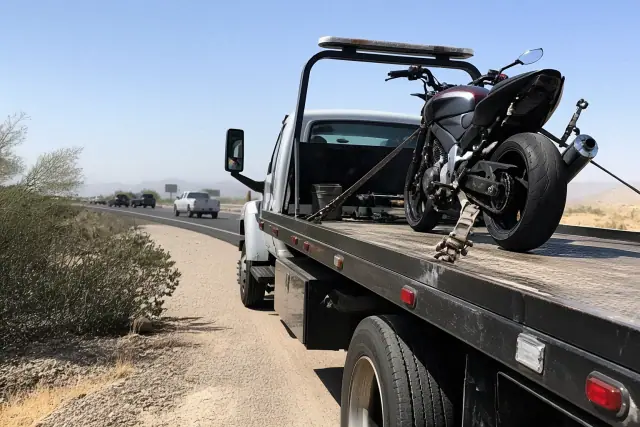
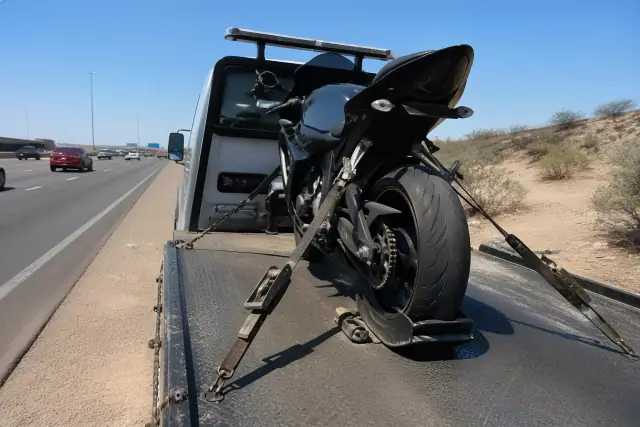
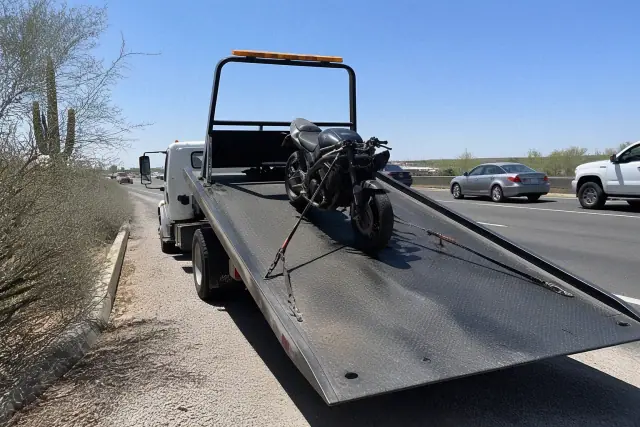
Motorcycle secured on a flatbed tow truck on the side of a highway in Phoenix, AZ.

Dispatch is staffed nights, weekends, and holidays for breakdowns on roads such as Loop 101 and the Piestewa Freeway. Local calls within Phoenix city limits typically receive a truck the same day, often within the hour depending on traffic on the 10 or the 17, with active-shoulder calls prioritized.

Request Estimate

Flatbed Motorcycle Towing

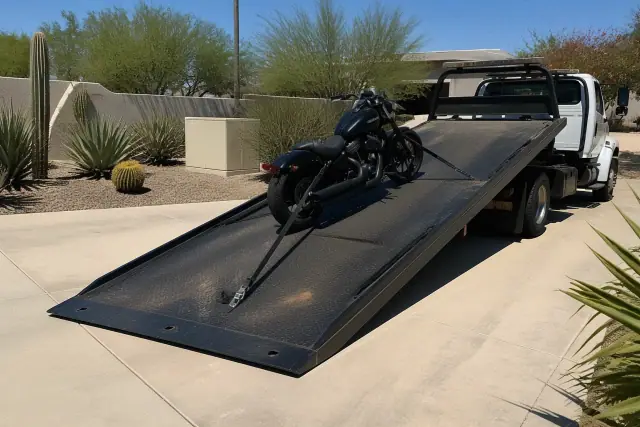
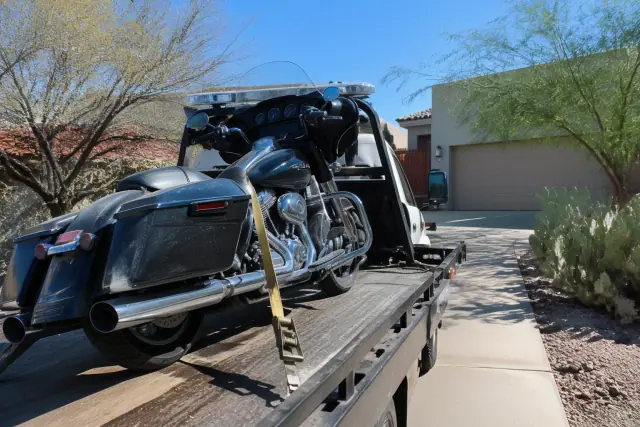
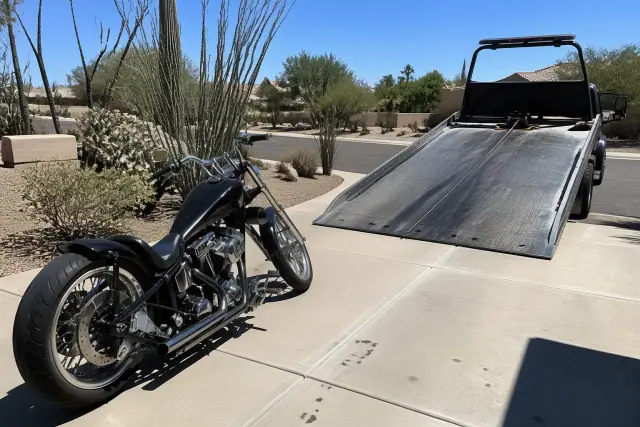
Motorcycle securely strapped to a flatbed tow truck on a residential driveway in Phoenix, AZ.

Every motorcycle we move is loaded onto a flatbed rather than pulled on its own wheels behind a hook. Wheel chocks, soft-tie straps, and a suitable ramp angle reduce road vibration, tire scrubbing, loading contact, and tip-over risk.

Request Estimate

Motorcycle Accident Recovery

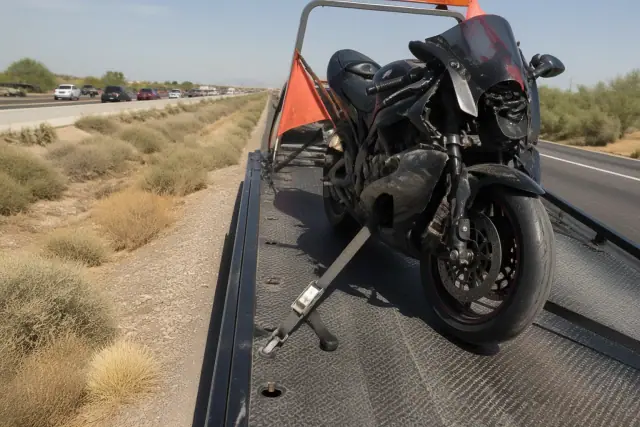
A motorcycle secured to a flatbed tow truck with straps on a gravel shoulder in Phoenix, AZ.

Collision recovery is handled differently from a routine mechanical breakdown. Crews coordinate with Phoenix Police or Arizona Department of Public Safety units at an active scene and photograph the bike's position before moving it when law enforcement requests documentation.

Request Estimate

Motorcycle Roadside Assistance

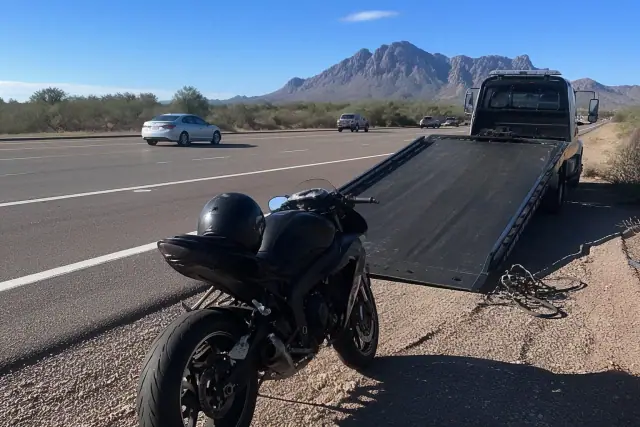
A disabled motorcycle parked on a gravel highway shoulder with desert mountains in the background in Phoenix, AZ.

Operators assess dead batteries, fuel-delivery problems, electrical faults, flat tires, and chain issues before recommending a tow. Jump-start equipment is calibrated for 6V and 12V motorcycle electrical systems, and some minor battery, chain, or tire issues can be resolved on scene.

Request Estimate

Long-Distance Motorcycle Transport

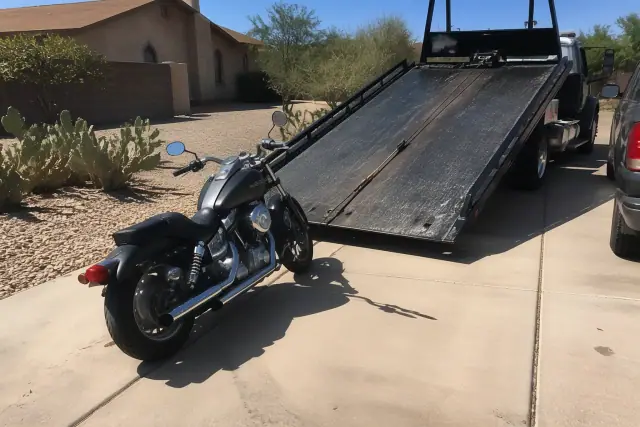
Motorcycle being loaded onto a tow truck on a driveway in Phoenix, AZ.

Long-distance transport serves riders relocating, purchasing a bike out of state, or sending a motorcycle for repair. Pickup windows and estimated transit times are coordinated for destinations across Arizona and neighboring states based on mileage and desert-corridor route conditions.

Request Estimate

Secured Motorcycle Storage

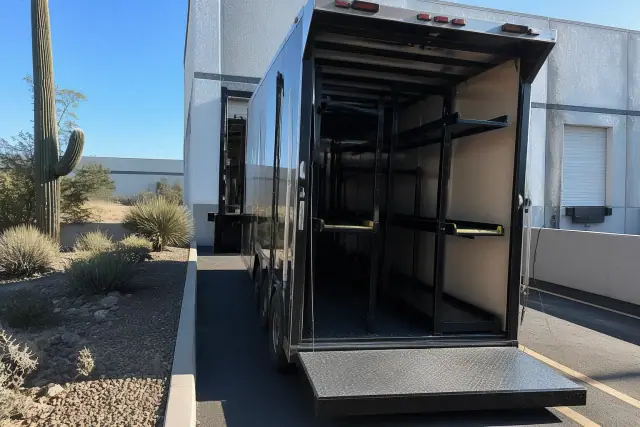
Motorcycles in a reinforced storage racking system at an industrial park in Phoenix, AZ.

When pickup and drop-off timing do not align, motorcycle storage is available in Phoenix before pickup or after delivery. The bike is kept in secured, monitored space instead of being left exposed on a public lot or roadside.

Request Estimate
Bike-Specific Transport

Motorcycle Transport Options

A sport bike, heavy touring cruiser, custom chopper, disabled motorcycle, and collision-damaged bike do not load or secure the same way. Our operators adjust ramp angle, chock placement, strap routing, and recovery equipment for the motorcycle and pickup conditions.

A motorcycle secured to a tow truck bed on the side of a highway in Phoenix, AZ.

Sport Bike Towing

Low-ground-clearance sport bikes need a shallower loading angle and carefully selected tie-down points. The front wheel is stabilized before soft straps are routed away from bodywork and sensitive components.

  • Shallow ramp angle for low ground clearance
  • Front-wheel chock before strap tension
  • Soft ties kept clear of fairings
  • No straps through spokes or brake lines
  • Undercarriage clearance checked while loading
Request Estimate
Motorcycle being loaded onto a tow truck on a driveway in Phoenix, AZ, with desert landscaping in the background.

Cruiser and Touring Bike Towing

Heavy cruisers and touring bikes need frame-based securing that accounts for their weight and bodywork. Reinforced deck anchor points carry the load while straps avoid the fairing, exhaust, and suspension components.

  • Frame-based tie-down points
  • Reinforced flatbed deck anchors
  • Soft straps clear of the fairing
  • Bike weight considered in securement
  • Flatbed transport without tire scrubbing
Request Estimate
Custom motorcycle on a residential driveway in Phoenix, AZ, being prepared for towing onto a hydraulic truck bed.

Custom Chopper Transport

Custom choppers and modified cruisers may have altered ride height, extended forks, or aftermarket exhaust that make standard loading points unsuitable. Ramp angle and strap placement are adjusted for the individual build rather than applied as a one-size setup.

  • Altered ride height assessed before loading
  • Extended forks accommodated
  • Aftermarket exhaust protected
  • Ramp angle adjusted to the build
  • Extra strap-placement time when needed
Request Estimate
Disabled motorcycle being secured onto a hydraulic tow truck on a highway shoulder in Phoenix, AZ.

Mechanical Breakdown Towing

A motorcycle that will not start may have a battery, fuel-delivery, tire, chain, or electrical problem. An on-scene assessment determines whether a roadside fix is appropriate or the motorcycle should be loaded onto the flatbed.

  • Dead-battery assessment
  • Fuel-delivery problem check
  • Flat-tire evaluation
  • Chain-failure inspection
  • Electrical-fault diagnostics
Request Estimate
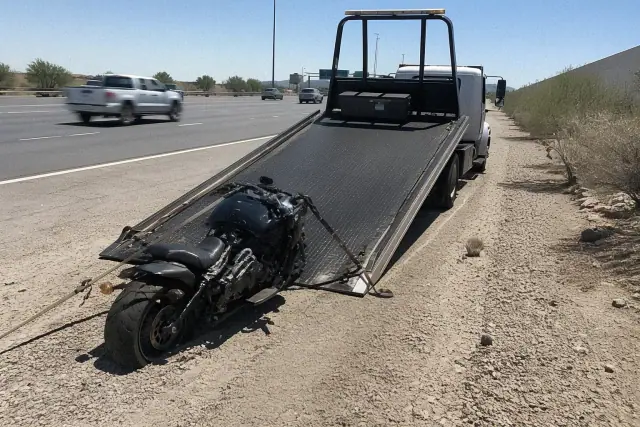
A damaged motorcycle secured to a flatbed tow truck on a desert roadside in Phoenix, AZ, with traffic in the background.

Collision and Difficult-Terrain Recovery

Canal banks, desert washes near the Salt River, and soft shoulder gravel along outer Loop 202 can require more than a routine flatbed approach. Recovery ramps and winch line are selected for uneven, sandy, or sloped terrain, while active collision scenes are coordinated with responding authorities.

  • Canal-bank recovery planning
  • Desert-wash access evaluation
  • Soft-shoulder gravel recovery
  • Ramps for sloped terrain
  • Winch line for controlled loading
Request Estimate
Finding the Right Response

Choosing the Right Motorcycle Towing Approach

The right response depends on the motorcycle's condition, size and weight, pickup accessibility, distance, and whether the rider is exposed on an active shoulder. Dispatch uses those details to decide whether to begin with roadside assistance, send a bike-configured flatbed, prepare for collision recovery, or arrange long-distance transport.

Motorcycle-Specific Flatbed Equipment

Hydraulic ramps with lower deck angles, rated front-wheel chocks, and soft nylon straps provide the foundation for secure motorcycle transport. This equipment replaces the car-oriented chain-and-hook or standard dolly methods that can damage a two-wheeled vehicle.

Bike-Specific Securing Techniques

Operators distinguish the shallow ramp and wheel-chock needs of a sport bike from the reinforced frame tie-downs of a heavy touring cruiser. Custom builds receive adjusted strap placement so paint, exhaust, fairings, and suspension parts are not used as contact points.

Prepared Motorcycle Dispatch

Before the truck leaves, dispatch asks for the mile marker, lane position, bike condition, and pickup access. The operator can then arrive with the appropriate straps, ramp angle, flatbed configuration, and recovery equipment already planned.

What Sets Us Apart

Why Phoenix Riders Choose Our Team

Motorcycle calls are dispatched with equipment and procedures designed around two-wheel vehicles, not treated as smaller car tows. We explain what to expect before arrival, inspect the motorcycle's securement before departure, and coordinate roadside help with flatbed dispatch when an on-scene fix is not enough.

Request Motorcycle Towing

Dead Motorcycle Battery

Heat can be hard on motorcycle batteries, leaving a bike unable to start after a stop or long ride. An operator can assess the electrical system and use motorcycle-calibrated jump equipment before recommending flatbed transport.

Flat Tire or Chain Failure

A flat tire or failed chain can stop a bike without warning and may leave the rider exposed near moving traffic. The operator evaluates whether the issue can be handled roadside or requires loading the motorcycle onto a flatbed.

Fuel or Electrical Fault

A no-start condition may trace to fuel delivery, an electrical fault, an empty tank, or a tripped kill switch. On-scene diagnostics help separate a minor issue from a problem that calls for transport to a repair destination.

Motorcycle Collision Damage

A collision-damaged motorcycle may have unstable steering, suspension, or bodywork that changes how it can be moved. Recovery crews coordinate with the active investigation and select contact points that do not add avoidable transport damage.

Low-Clearance or Custom Bike

Low fairings, altered ride height, extended forks, and aftermarket exhaust can create loading and securing conflicts. A shallower ramp and individualized tie-down plan help prevent scraping or pressure on modified components.

Uneven or Sandy Pickup Location

Desert washes, canal banks, sloped ground, and loose shoulder gravel can limit ordinary flatbed positioning. Recovery ramps and winch line allow more controlled movement toward a stable loading surface.

How It Works

Our Motorcycle Towing Process

A safe motorcycle tow begins before the truck arrives and continues through the securement check at the pickup location. Each step is adjusted to the bike's condition, geometry, destination, and roadside environment.

01.

Share Your Location and Bike Details

Tell dispatch the mile marker or pickup address, lane position, motorcycle type, visible damage, and whether the bike can roll. These details help identify shoulder hazards, access limits, and equipment needs.

02.

Assess Roadside Options

The operator checks whether a battery, fuel, chain, tire, or electrical issue can be handled safely at the scene. If the roadside fix is not appropriate or does not work, the same operator coordinates the flatbed.

03.

Configure the Flatbed

Ramp angle, wheel-chock position, deck anchors, and winch use are selected for the bike's ride height, weight, modifications, and terrain. Sport bikes, touring cruisers, and custom choppers receive different loading setups.

04.

Load Into the Wheel Chock

The motorcycle moves up the low-angle ramp and its front wheel enters the chock first. Locking wheel direction before applying straps establishes a stable position on the deck.

05.

Secure and Inspect the Motorcycle

Soft-tie straps run at roughly 45-degree angles from a suitable lower-fork or frame point to the deck anchors, never through spokes, brake lines, or fairing panels. The operator checks strap tension and chock placement before departure without over-compressing the fork seals.

06.

Transport and Coordinate Drop-Off

The flatbed carries the motorcycle to the requested local destination, storage location, or long-distance drop-off. For longer routes, pickup windows and estimated transit timing are coordinated from mileage, fuel needs, and route conditions.

Get Motorcycle Help

Schedule Motorcycle Towing in Phoenix

Tell us where the motorcycle is, what happened, what type of bike you have, and where it needs to go. We will explain the expected response, determine whether roadside assistance or a flatbed fits the situation, and quote the fee structure before dispatch.

Motorcycle Towing Help

Motorcycle Towing FAQs

These answers cover motorcycle towing equipment, pricing, roadside help, response timing, long-distance transport, and what dispatch needs from riders in Phoenix.

Call About Motorcycle Towing

Yes, but not every towing company carries equipment designed for two-wheeled vehicles. Phoenix Towing Co. dispatches motorcycle calls with a flatbed, wheel chocks, low-clearance ramps, and soft-tie straps instead of a general car wrecker setup.

Phoenix-market motorcycle towing generally starts with a $75 to $125 hook-up fee plus roughly $3 to $6 per mile. After-hours, holiday, or emergency dispatch typically adds a $50 to $150 surcharge, and bike size, pickup access, distance, and time of day can affect the final cost. We disclose the fee structure before the truck rolls.

The 12-second rule is a riding-safety technique, not a towing procedure. It tells riders to scan the road 12 seconds ahead for hazards, surface changes, or obstacles so they have more time to react.

AAA offers motorcycle towing under some membership tiers, but coverage and mileage limits vary by plan and region. Riders without motorcycle-specific coverage or outside a plan's mileage radius can call Phoenix Towing Co. directly without a membership requirement and receive the rate structure before dispatch.

A standard flatbed can physically carry a motorcycle, but safe loading still calls for a wheel chock, soft-tie straps, and a suitable ramp angle. Chain-and-hook equipment or a car dolly can create avoidable contact, tire scrubbing, or tip-over risk.

Using the typical $3 to $6 per-mile range plus a $75 to $125 hook-up fee, a 100-mile motorcycle tow generally falls between $375 and $725. Exact pricing depends on the route, bike size, access, and time of day, while longer jobs may be quoted at a flat rate. Request a direct quote for trips over 50 miles because fuel and transit time affect longer hauls.

Move the bike as far onto the shoulder as safely possible and use hazard lighting if equipped. Check the kill switch, fuel level, and other obvious causes, but avoid attempting a repair in an exposed freeway position. Call roadside assistance so an operator can assess the battery, fuel, chain, tire, or electrical system and arrange a flatbed if needed.

Local calls within Phoenix city limits typically receive a truck the same day and often within the hour, depending on traffic on the 10 or the 17. Calls involving a disabled rider on an active shoulder are prioritized, while actual arrival time still depends on location and traffic.

Sometimes. An operator first checks for battery, fuel, chain, tire, or electrical problems, and minor issues may be resolved on scene. If the fix does not get the bike moving safely, the same operator coordinates a motorcycle-ready flatbed.

The front wheel enters a rated wheel chock first to stabilize direction. Soft-tie straps then run at roughly 45-degree angles from suitable lower-fork or frame points to the deck anchors, avoiding spokes, brake lines, and fairing panels. Strap tension and chock placement are inspected before transport.

Yes. Sport bikes receive shallow ramp angles and front-wheel support, while heavy touring cruisers use reinforced frame tie-down points. Custom choppers may require adjusted ramp angles and strap placement for altered ride height, extended forks, or aftermarket exhaust.

Yes. Long-distance transport runs from Phoenix to destinations across Arizona and neighboring states for relocations, out-of-state purchases, and repair trips. Pickup windows and estimated transit times are based on total mileage and route conditions, and secured monitored storage is available in Phoenix when timing requires it.

Share your address or mile marker, lane position, motorcycle type, bike condition, pickup access, and requested destination. Mention low clearance, extended forks, collision damage, soft terrain, or a bike that cannot roll so the operator can prepare the right straps, ramp angle, flatbed configuration, and recovery equipment.