Proudly serving Phoenix, Glendale, Scottsdale, Tempe, Mesa, Chandler & surrounding areasCall or Text 24/7: 480-245-5233
Aerial drone view of the urban landscape, foothills, and residential sprawl in Phoenix, AZ.

Mobile Jump Start Service and Battery Diagnostics in Phoenix, AZ

Phoenix Towing Co. provides mobile jump start service and roadside assistance throughout Phoenix and the surrounding metro. Crews also handle 24-hour towing, emergency towing, flatbed towing, local and long-distance towing, accident recovery, motorcycle towing, and car lockout service. Technicians arrive with portable jump packs and diagnostic equipment suited to standard cars, trucks, diesel vehicles, and RV battery systems. Drivers can call from a driveway, parking garage, highway shoulder, or other roadside location.

Phoenix summers can push pavement temperatures past 150 degrees and cabin temperatures well beyond 120, accelerating battery corrosion and electrolyte loss. Dead-battery calls rise from June through August as heat-damaged batteries lose the power to crank. A professional connection sequence helps protect fuses and sensitive onboard computers from cable mistakes. After the engine starts, on-site checks can reveal whether the battery, alternator, or starter is the larger problem.

Every service truck carries load-testing equipment that meets SAE J537 standards for lead-acid battery service, along with tools for checking alternator output and starter draw. The family-owned, veteran-owned operation uses certified roadside technicians and licensed, insured drivers.

Phoenix Towing Co. provides jump start service throughout Phoenix and nearby Glendale, Mesa, Scottsdale, Tempe, Chandler, and Gilbert.

★ ★ ★ ★ ★4.9/5 Average Rating · 20+ Years of Experience · Thousands of Customers Helped · Licensed & Insured · Residential & Commercial

Jump Start Options & Benefits

What Is Mobile Jump Start Service?

Mobile jump start service brings a technician, a correctly sized jump pack, and testing equipment to the disabled vehicle. The driver does not need to move the car or locate an open repair shop before help can begin.

Before connecting power, the technician checks the battery case, terminals, and surrounding area for cracks, corrosion, leaking electrolyte, and other hazards. The battery is then connected to a grounded power source in a controlled sequence.

Once the vehicle runs, a multimeter check can show whether the charging system is restoring power. If the engine still will not start, the technician can identify signs of battery, starter, alternator, or other mechanical trouble and arrange flatbed towing to the driver's chosen shop.

Benefits of Professional Jump Start Service

Professional roadside help combines safe battery connections with useful diagnosis and a clear next step. That matters when an incorrect cable order or bad ground could damage a fuse box or onboard electronics.

  • Staffed dispatch around the clock
  • Closest-unit routing based on GPS locations
  • Realistic arrival estimate before the truck leaves
  • Battery case and terminal safety inspection
  • Controlled cable connection and removal sequence
  • Post-start alternator and starter checks
  • Jump packs sized for cars, trucks, diesels, and RVs
  • Upfront phone pricing without a membership
Roadside Battery Help

Phoenix Jump Start Services

A no-start call can involve a discharged battery, a failed charging component, heat damage, or a starting system that needs more power than a basic jump box can deliver. These mobile services cover the immediate start and the checks that help determine what should happen next.

24/7 Mobile Jump Starts

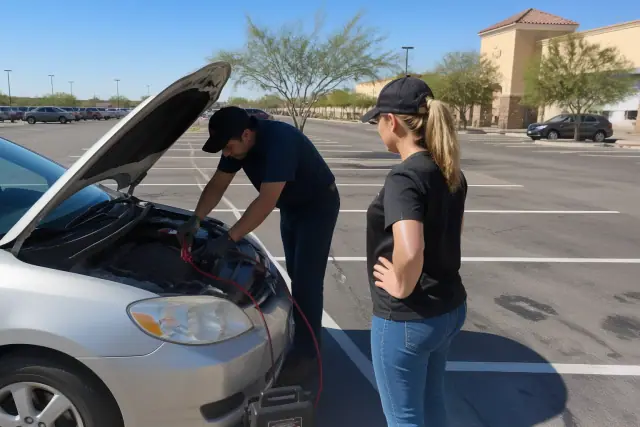
Technician using jumper cables on a car with an open hood in a Phoenix, AZ shopping center parking lot.

Dispatch answers 24 hours a day, every day of the year, for vehicles stranded at homes, workplaces, parking garages, and roadside locations. Every call receives a same-day response, and the overwhelming majority are handled within an hour of the initial call, depending on traffic and location.

Request Estimate

On-Site Battery Diagnostics

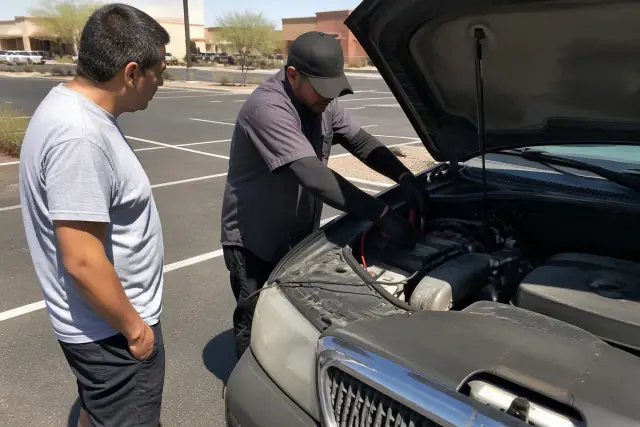
Technician performing a jump-start on a car with the hood open in a Phoenix, AZ shopping center parking lot.

Load-testing tools help distinguish a discharged battery from one that can no longer hold useful power. Technicians also compare symptoms such as slow cranking, clicking, dim lights, and a completely dark electrical system before recommending a jump, replacement, or tow.

Request Estimate

Alternator and Starter Checks

A technician performing alternator and starter checks on a vehicle in a Phoenix, AZ parking lot.

After a successful start, a multimeter check confirms whether alternator output appears sufficient to recharge the battery. If the engine will not crank, technicians also look for starter failure or a seized engine so a battery jump is not treated as the answer to every no-start condition.

Request Estimate

Heavy-Demand Truck Jump Starts

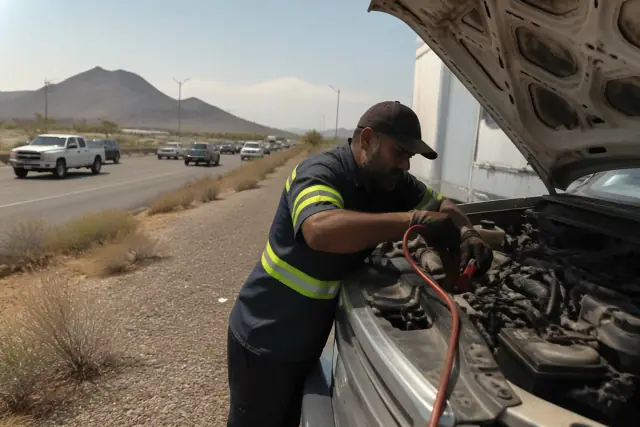
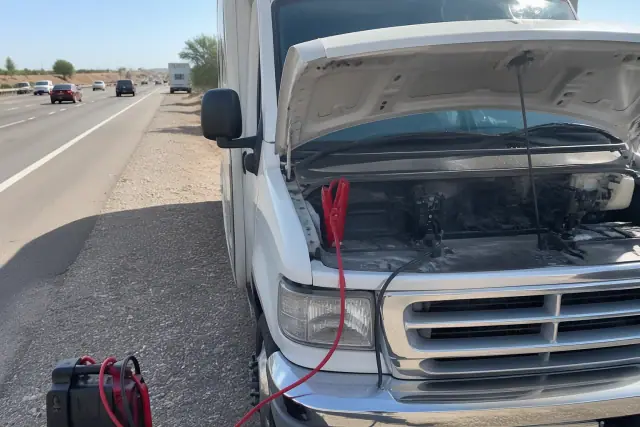
Technician connecting jumper cables to a truck battery on a highway shoulder in Phoenix, AZ.

Pickup trucks and larger vehicles may use dual batteries or higher cold-cranking-amp batteries than a standard sedan. Service trucks carry heavy-duty jump units and cable sets designed for those higher-demand starting systems.

Request Estimate

RV Dual-Battery Jump Starts

Technician using jumper cables to jump-start dual RV batteries in a sunny Phoenix, AZ parking lot.

RVs and larger recreational vehicles often separate their house and engine battery banks. The technician identifies and isolates the correct starting battery before applying power, helping avoid disruption to onboard electronics.

Request Estimate

Flatbed Towing After a No-Start

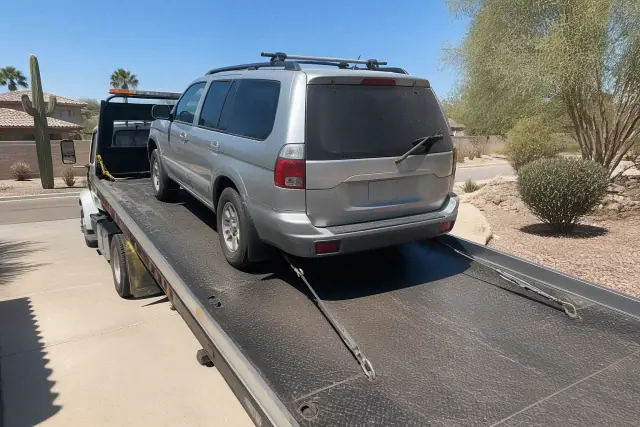
Vehicle being winched onto a flatbed tow truck on a concrete driveway in Phoenix, AZ.

When a jump does not resolve the problem, roadside help does not end with another dead vehicle. Phoenix Towing Co. can arrange flatbed towing to the driver's shop of choice after explaining signs of battery, alternator, starter, or other mechanical failure.

Request Estimate
Vehicle & Battery Needs

Jump Start Service for Different Needs

Battery location, starting demand, vehicle use, and electrical layout affect how a jump should be handled. Matching the equipment and connection point to the vehicle is especially important for larger engines, multiple battery banks, and batteries weakened by long periods of parking.

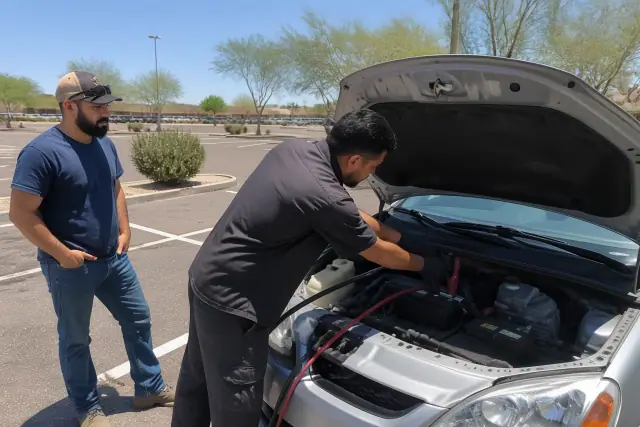
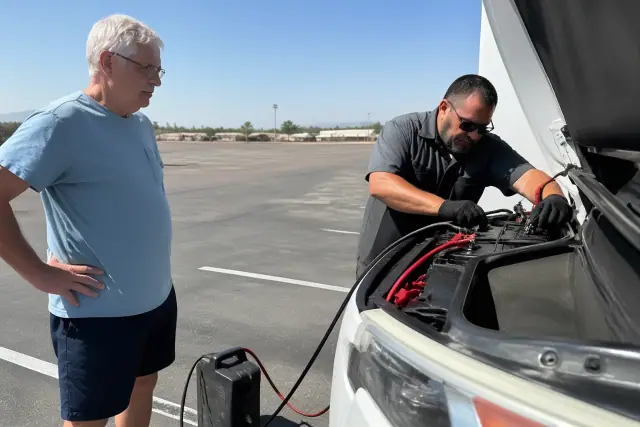
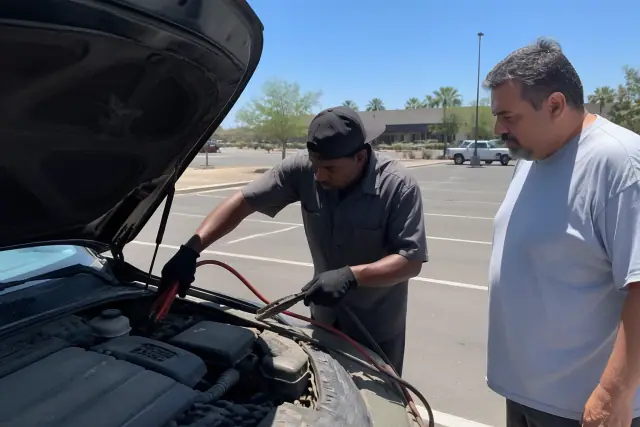
Technician using jumper cables on a car battery in a parking lot in Phoenix, AZ, with the owner standing nearby.

Standard Cars and Crossovers

Sedans, hatchbacks, and crossovers make up the majority of standard jump start calls across Phoenix, Glendale, Mesa, and Tempe. Portable jump packs provide controlled starting power without requiring another driver's vehicle.

  • Battery case and terminal check
  • Portable jump pack connection
  • Unpainted metal ground point
  • Stable idle before disconnecting
  • Charging-system check after starting
Request Estimate
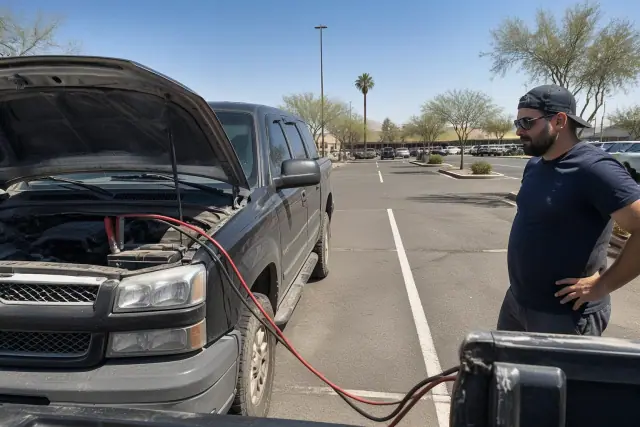
Jumper cables connected to a truck battery in a sunlit parking lot in Phoenix, AZ.

Pickup Trucks and Larger Vehicles

Larger vehicles can require more starting power and may be equipped with dual batteries or higher cold-cranking-amp batteries. Heavy-duty units help meet that demand without relying on a passenger-car jump box.

  • Higher-demand jump packs
  • Dual-battery layout check
  • Heavy-duty cable sets
  • Correct battery connection point
  • Post-start voltage assessment
Request Estimate
Technician connecting jumper cables to a vehicle battery in a shopping center parking lot in Phoenix, AZ.

Diesel Starting Systems

Diesel engines need significantly more amperage to turn over than everyday passenger vehicles, particularly when cranking a cold engine. Jump boxes and cables sized for diesel starting systems deliver the required power more reliably.

  • Diesel-rated jump equipment
  • High-amperage starting support
  • Battery-bank identification
  • Terminal and cable inspection
  • Charging-output check
Request Estimate
Jumper cables connected to dual battery banks under the open hood of a vehicle on a roadside in Phoenix, AZ.

RVs and Dual Battery Banks

Many RVs use separate house and engine battery systems, so connecting to the wrong bank can affect onboard electronics without solving the starting problem. The correct engine battery is isolated before the jump begins.

  • House-bank identification
  • Engine-battery isolation
  • Onboard electronics protection
  • Heavy-duty starting power
  • Engine charging check
Request Estimate
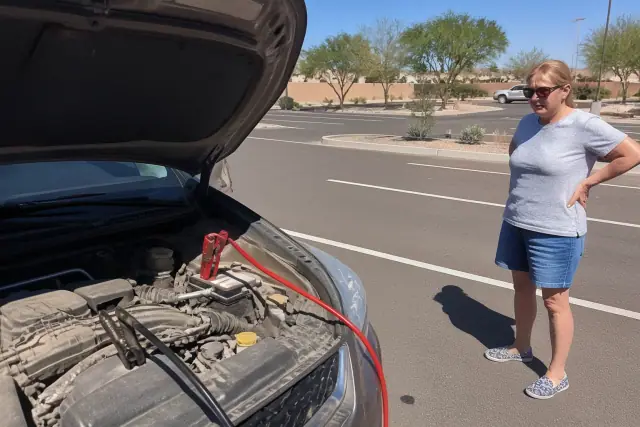
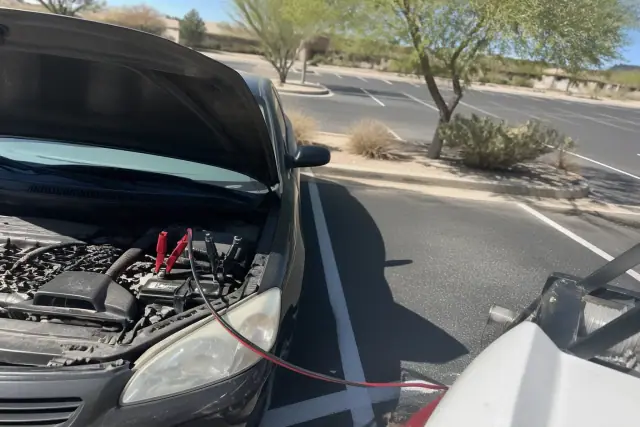
Technician using jumper cables on a car battery with an open hood in a Phoenix, AZ parking lot with desert landscaping.

Parked and Infrequently Used Vehicles

Second cars, weekend trucks, and vehicles parked during travel can lose charge quickly in Arizona heat because higher temperatures increase battery self-discharge. Mobile service reaches the vehicle where it has been sitting.

  • Second-car battery starts
  • Weekend-truck assistance
  • At-home mobile response
  • Battery condition check
  • Alternator output check
Request Estimate
Prepared for the Call

Choosing the Right Jump Start Approach

The safest approach depends on the vehicle, the battery's physical condition, the symptoms at the key, and whether the charging system can sustain the start. Phoenix Towing Co. combines staffed dispatch, metro route knowledge, and truck-based diagnostic equipment to make those decisions at the vehicle.

Around-the-Clock Dispatch

A real dispatcher answers day or night, gathers the location and vehicle details, and identifies the closest available unit. Drivers receive a realistic arrival estimate and a direct way to check status if Phoenix traffic changes the timing.

Phoenix Metro Route Knowledge

Phoenix covers 517.9 square miles, so truck position and traffic conditions can materially affect response time. Crews familiar with I-10, Loop 202, the 101, I-17, and the wider Salt River Valley can choose routes based on the driver's actual location.

On-Truck Diagnostic Equipment

Portable jump packs, load-testing tools, multimeters, and heavy-duty cable sets let technicians handle different starting systems and check what happens after the jump. That equipment supports a diagnosis instead of treating every no-start as an identical battery problem.

What Sets Us Apart

Why Choose Phoenix Towing Co. for Jump Start Service?

Phoenix Towing Co. is a family-owned, veteran-owned operation with certified roadside technicians and drivers licensed and insured under Arizona commercial regulations. The team pairs Phoenix route knowledge with documented battery procedures, honest phone quotes, and clear explanations when a jump reveals a larger electrical or mechanical issue.

Request Jump Start Service

Slow Engine Cranking

An engine that turns over slowly is a classic sign that the battery cannot supply normal starting power. Scheduling a battery check at this stage can prevent the next start attempt from becoming a complete breakdown.

Clicking or Dimming Lights

Rapid clicking, dashboard lights that dim with the key, or an electrical system that goes completely dark can point to a discharged or failing battery. Headlights and radio that remain strong while the engine will not crank may also direct attention toward the starter.

Heat-Aged Battery

Standard flooded lead-acid batteries are commonly rated for roughly 3 to 5 years, but Phoenix heat can shorten that service life. Repeated triple-digit temperatures from May through September accelerate internal plate corrosion and electrolyte evaporation even when the vehicle otherwise runs normally.

Swollen, Cracked, or Leaking Battery

Case swelling can develop after months of heat cycling, while cracks or leaking electrolyte indicate a compromised battery. A damaged battery is flagged for replacement instead of a jump because a spark near hydrogen gas buildup can create a serious safety hazard.

Battery Drain While Parked

A vehicle that sits for more than a week or two can return to a noticeably weaker start. Arizona heat increases battery self-discharge, making second cars, weekend trucks, and vehicles parked during travel more vulnerable.

Starter or Alternator Failure

Alternator failure can look like a battery problem when the vehicle starts from outside power but cannot maintain a charge. Starter failure or a seized engine can also prevent cranking, so testing helps avoid paying for a jump that cannot solve the actual fault.

How It Works

Our Professional Jump Start Process

A proper jump can take only minutes after the technician arrives, but the inspection, connection order, and post-start checks are essential. The process below protects the vehicle while giving the driver a practical next step if the battery is not the only problem.

01.

Share Your Location and Vehicle

Dispatch asks for the location, vehicle make and model, and whether the engine cranks slowly or does nothing. Those details help the technician arrive with equipment appropriate for the starting system.

02.

Dispatch the Closest Technician

Dispatchers use available-unit GPS locations to send the closest technician instead of relying only on call order. The driver receives an arrival estimate based on distance, traffic, time of day, and current call volume.

03.

Inspect the Battery and Terminals

Before making a connection, the technician checks for a swollen or cracked case, terminal corrosion, leaking electrolyte, and other unsafe conditions. A compromised battery is not jump-started.

04.

Connect the Jump Equipment Safely

The positive connection is made positive to positive, followed by the negative connection to an unpainted metal ground point away from the battery. This order reduces spark risk near the battery.

05.

Start and Stabilize the Vehicle

The vehicle is started and allowed to stabilize while the technician monitors its response. Once operation appears steady, the cables are removed in reverse order.

06.

Check the Charging and Starting Systems

A multimeter check evaluates alternator output, while the technician considers battery condition and starter draw. If the vehicle is likely to fail again or never starts, the driver receives an explanation of battery replacement or towing options before any additional work.

Roadside Help Where You Are

Request Mobile Jump Start Service

Tell dispatch where the vehicle is, what you drive, and what happens when you turn the key. Phoenix Towing Co. will provide an arrival estimate and phone quote before sending an equipped roadside technician.

Battery & Roadside Help

Jump Start Service FAQs

These answers cover jump start pricing, Phoenix service coverage, response timing, vehicle types, and the steps used to protect the battery and electrical system. Call if your vehicle's symptoms or battery layout require a more specific answer.

Call for Jump Start Help

Jump start service in the Phoenix market typically runs between $50 and $120, depending on time of day, location, and distance from the responding truck. Late-night calls and trips to outlying metro areas can fall toward the higher end. Phoenix Towing Co. provides the price by phone before dispatch, without a membership fee or surprise roadside mileage add-on.

Phoenix Towing Co. serves Phoenix and the surrounding metro, including Glendale, Mesa, Scottsdale, Tempe, Chandler, Gilbert, Peoria, Surprise, Avondale, and Litchfield Park. A technician comes to the vehicle at a driveway, parking garage, workplace, highway shoulder, or other roadside location.

Call Phoenix Towing Co. for mobile jump start service anywhere in the supported Phoenix metro area. Dispatch sends a licensed, insured technician with load-testing tools and jump packs selected for the vehicle. Unless there is an immediate public-safety risk, a dedicated roadside company is the appropriate choice for a routine dead-battery call.

Extreme heat accelerates corrosion inside a lead-acid battery and increases electrolyte evaporation. Repeated heat cycling can weaken internal plates and swell the battery case before a total failure occurs. Vehicles left unused can also lose charge faster because heat increases the battery's self-discharge rate.

An incorrect cable order or poor ground can blow fuses or damage sensitive onboard computers. A professional process connects positive to positive first, then negative to an unpainted metal ground away from the battery. The technician also checks for cracks or leaks before connecting because a compromised battery can be unsafe to jump.

Timing depends on the distance from the closest available unit, traffic, time of day, and current call volume. Central Phoenix is often faster than outlying areas because of truck positioning. Dispatch provides a realistic arrival estimate and sends the closest available technician using GPS locations.

Yes. The dispatch line is staffed around the clock for jump start calls before sunrise, after a night shift, on weekends, and at other times when repair shops may be closed. Service is available throughout the supported Phoenix metro area.

The technician checks for signs of a failed starter, alternator trouble, a completely failed battery, or another mechanical problem. If the jump cannot restore operation, Phoenix Towing Co. can arrange flatbed towing to the driver's chosen shop and explain the next step before additional work begins.

Slow cranking, clicking, dim dashboard lights, or a completely dark electrical system often point toward the battery. If the headlights and radio work normally but the engine will not crank, the starter may be involved. On-site battery, starter, and alternator checks provide a clearer answer.

Yes. Pickup trucks and larger vehicles may need heavy-duty jump packs because they use higher cold-cranking-amp batteries or dual-battery setups. Diesel starting systems require substantially more amperage, so the truck carries jump boxes and cable sets sized for that demand.

Yes. Many RVs have separate house and engine battery banks, and the technician identifies the correct starting battery before connecting power. This approach avoids disturbing the house system or onboard electronics while addressing the engine no-start.

The technician first inspects the battery case, terminals, and surrounding area. After making the positive and grounded negative connections in sequence, the vehicle is started, stabilized, and disconnected in reverse order. A post-start check evaluates charging output and whether the battery is likely to fail again.

Provide your exact location, vehicle make and model, and what happens when you turn the key. Mention slow cranking, clicking, dim lights, or no electrical response, along with whether the vehicle is a diesel, larger truck, or RV. Those details help dispatch send the appropriate jump equipment.